request to quote
Leave Your Message

China Top 10 Shipbuilding Welding Robot Manufacturers

China’s shipbuilding industry is moving toward smarter, cleaner, and more consistent production. Welding remains a demanding process, especially around curved hull sections, stiffeners, and large steel assemblies. A reliable Shipbuilding Welding Robot can reduce repetitive work, improve weld uniformity, and support safer operations near heavy structures.

This guide introduces China’s top 10 shipbuilding welding robot manufacturers through practical industry criteria. It considers robot payload, welding accuracy, torch control, seam tracking, programming flexibility, and integration with production lines. It also reviews technical support, operator training, maintenance response, and documented project experience. Factory demonstrations, certification records, and customer references matter more than attractive product brochures. Real performance shows in stable arcs, clean weld beads, and fewer interruptions during long shifts.

The ranking should not be treated as an absolute verdict. Manufacturer strengths differ across ship sizes, welding positions, materials, and workshop layouts. Some companies may excel in customized systems but offer limited overseas service. Others may provide strong hardware while requiring more integration work. That distinction deserves attention. Buyers should test sample welds, inspect safety functions, and calculate total ownership costs before signing contracts. Even experienced teams can overlook software compatibility or spare-part availability. Careful verification remains essential when selecting a long-term automation partner.
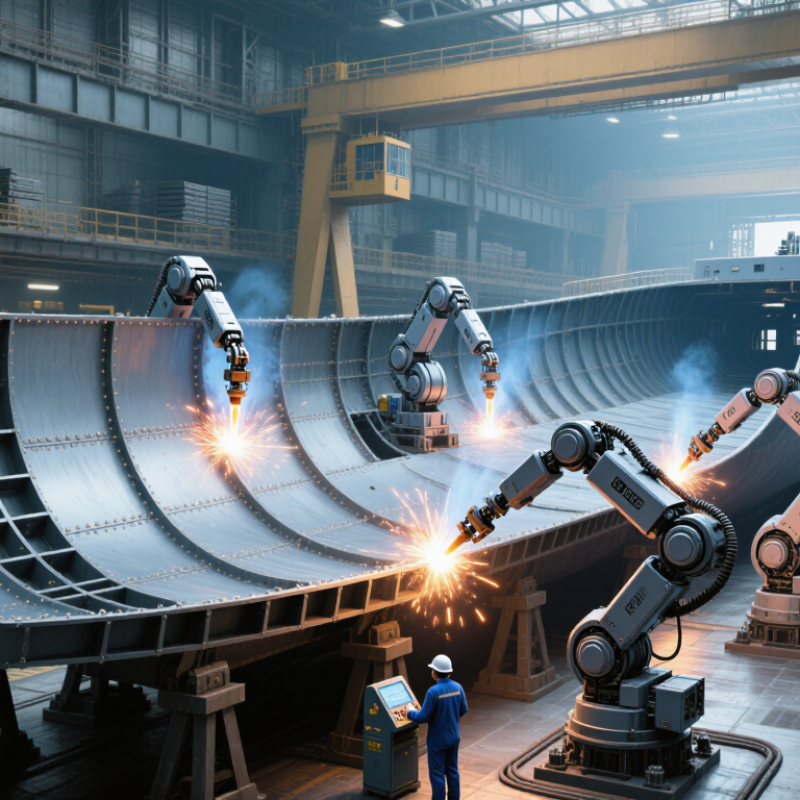
China Top 10 Shipbuilding Welding Robot Manufacturers

Definition and Role of Welding Robots in Shipbuilding

Welding robots are programmable systems that move torches along prepared joints, often with sensors, positioners, and seam-tracking software. In shipbuilding, they weld long plate seams, stiffeners, brackets, and curved sections under controlled conditions. Unlike a fixed factory line, a shipyard handles changing designs, tight spaces, rust, heat, and uneven plate alignment. The robot must adapt, not merely repeat.

The pressure is measurable. UNCTAD’s Review of Maritime Transport 2024 reported that seaborne trade grew by about 2.4% in 2023, increasing demand for efficient vessel production. The International Federation of Robotics recorded 541,302 industrial robot installations worldwide in 2023. However, this figure covers every industry, not shipbuilding alone. That distinction matters. A welding robot can improve arc consistency, reduce rework, and record parameters for quality audits. It can also keep workers away from intense radiation, fumes, and awkward welding positions. The risk remains.

Professional implementation should follow qualified welding procedures, welder or operator competence requirements, and traceable inspection records. ISO 14732 addresses welding personnel for mechanized and automatic welding, while ISO 3834 supports quality control for fusion welding. Yet automation is not magic. Poor fit-up, distorted plates, or incorrect programming can produce repeated defects faster. Experienced technicians still inspect starts, stops, penetration, and access. Not every weld should be automated. Shipyards choosing among leading manufacturers should examine sensor performance, offline programming, service response, and compatibility with classification requirements, rather than counting robot speed alone.
China Top 10 Shipbuilding Welding Robot Manufacturers — Definition and Role of Welding Robots in Shipbuilding

Welding robots are programmable systems that combine a robotic arm, welding power source, torch, sensors, and control software. In shipbuilding, their main value is consistent weld quality, repeatable torch movement, improved productivity, and reduced exposure to welding fumes, heat, and confined working conditions. The chart presents a normalized role-emphasis index for common shipbuilding welding robot functions; it does not compare manufacturers or brands.

Index basis: 100 represents the highest relative importance among the listed functions in typical robotic shipbuilding welding workflows. The values are an editorial comparison of application priorities rather than company performance data.

How China’s Shipbuilding Welding Robot Industry Developed

China’s shipbuilding welding robot industry grew from basic mechanized welding cells into flexible systems for large, irregular structures. Early equipment mainly repeated short welds on prepared plates. Shipyards soon demanded more accuracy, longer operation, and fewer interruptions. This pressure encouraged local manufacturers to develop robotic arms, positioners, seam-tracking sensors, and dedicated control software.

Modern systems can follow curved seams, adjust welding speed, and compensate for small gaps between steel plates. In a typical workshop, a robot may weld a panel while cameras inspect joint alignment and operators monitor arc stability. Digital models also support offline programming, reducing setup time near large blocks. However, shipbuilding remains difficult. Heat distortion, rust, changing plate thickness, and narrow working spaces still challenge automation.

The leading manufacturers are increasingly judged by practical performance, not brochure specifications. Important factors include weld consistency, sensor reliability, operator training, maintenance response, and integration with existing yard equipment. Some suppliers offer modular systems that can move between production lines. Others focus on heavy-duty gantry robots for oversized sections. Progress is real, but not perfectly smooth. A robot may perform brilliantly on standard panels and struggle on a unique hull section. Skilled welders therefore remain essential for inspection, adjustment, and difficult repairs. This balance between automation and human judgment continues to shape China’s industry.

China Top 10 Shipbuilding Welding Robot Manufacturers - How China’s Shipbuilding Welding Robot Industry Developed

Ten evidence-based industry milestones and market indicators; company names, brand names, and company-level rankings are intentionally excluded.

No. Year / Period Development Milestone or Indicator Relevance to Shipbuilding Welding Robot Development Public Reference
1 1978 onward Industrial reform and expanding international shipbuilding demand The shift toward export-oriented shipbuilding increased pressure to improve welding productivity, dimensional consistency, production safety, and repeatability in large steel structures. China shipbuilding industry development history; national industrial policy records
2 1980s–1990s Expansion of automated cutting, welding, panel-line, and block-production equipment Mechanized production created the process foundation for later robotic welding cells, especially in flat panels, stiffeners, longitudinal seams, and repetitive block work. Shipyard production-technology development literature
3 2000s Broader use of industrial robots and computer-integrated manufacturing Robotic welding became more practical for high-volume and repeatable joints, while CAD/CAM data, fixtures, positioners, and offline programming improved process integration. Chinese industrial-robot and intelligent-manufacturing development reports
4 2015 Made in China 2025 identified intelligent manufacturing and high-end equipment as strategic priorities The policy environment encouraged shipyards and equipment suppliers to invest in automation, digital production lines, sensing, industrial software, and robotic welding systems. State Council, Made in China 2025
5 2016–2020 National robot-industry and intelligent-manufacturing initiatives accelerated Funding, demonstration projects, technical standards, and domestic supply-chain development supported wider deployment of robots, controllers, sensors, welding power sources, and integration services. China Robot Industry Development Plan (2016–2020); intelligent-manufacturing action plans
6 Typical applications Robotic welding concentrated on repetitive steel joints and structured production zones Common application areas include hull panels, T-joints, stiffeners, flat-bar structures, deck sections, block assembly, and positioner-based welding. Complex curved or highly variable joints still require advanced sensing and human intervention. Shipbuilding automation engineering practice
7 2021–2025 The 14th Five-Year Plan emphasized digitalization, intelligent manufacturing, and industrial upgrading Shipbuilding automation increasingly moved from stand-alone welding robots toward connected production cells featuring traceability, production data collection, digital work instructions, and integrated quality control. China 14th Five-Year Plan; national intelligent-manufacturing policy documents
8 2023 China’s manufacturing robot density reached approximately 470 robots per 10,000 employees This national indicator reflects a mature and expanding industrial-robot ecosystem. It is a manufacturing-wide figure, not a shipbuilding-welding-specific measure. International Federation of Robotics, World Robotics 2024
9 2024 China accounted for about 55.7% of global shipbuilding output, 74.7% of new orders, and 63.1% of orderbook by deadweight tonnage China’s global shipbuilding scale creates a large addressable market for welding automation, retrofit projects, robotic production lines, process engineering, and after-sales maintenance. China Association of the National Shipbuilding Industry, 2024 industry statistics
10 Current development direction Integration of robots with laser vision, seam tracking, digital twins, data platforms, and adaptive welding The industry is progressing from fixed-path automation toward flexible systems that can identify joint deviations, compensate for fit-up variation, monitor weld quality, and connect production data with shipyard management systems. Recent shipbuilding automation research and intelligent-manufacturing projects

Key Technologies Used by Leading Chinese Manufacturers

China Top 10 Shipbuilding Welding Robot Manufacturers

Key Technologies Used by Leading Chinese Manufacturers

China’s shipbuilding scale is accelerating welding automation. The Ministry of Industry and Information Technology reported 2024 output of 48.1 million deadweight tons, representing 54.6% of global production. New orders reached 74.7% of the global total. These figures increase pressure for stable, high-speed welding systems.

Leading manufacturers commonly combine robotic arms with laser vision and real-time seam tracking. The sensors identify weld gaps, plate distortion, and changing joint positions. Adaptive control then adjusts travel speed, wire feed, and current during production. This matters when large panels move slightly under heat stress. Small deviations can create expensive rework.

Digital twins and offline programming are also becoming practical tools. Engineers can test robot paths before equipment enters a crowded workshop. Manufacturing execution systems record weld parameters, inspection results, and operator interventions. The IFR World Robotics 2024 report recorded 542,000 industrial robot installations worldwide in 2023, showing wider acceptance of robotic production. Still, automation is not magic. Salt residue, irregular bevels, and poor fit-up can confuse vision systems. That weakness deserves more attention. Skilled technicians remain essential for calibration, exception handling, and final quality judgment. Conversational programming may reduce training time, but it can also hide weak process knowledge. Reliable deployment needs both measurable data and disciplined human review.

Evaluation Criteria for China’s Top Ten Manufacturers

China Top 10 Shipbuilding Welding Robot Manufacturers

Evaluation Criteria for China’s Top Ten Manufacturers

A credible ranking should measure field performance, not showroom appearance. China installed 276,288 industrial robots in 2023, representing 51% of global installations, according to the International Federation of Robotics’ World Robotics 2024 report. However, general robot adoption does not prove shipbuilding capability. Evaluation should examine welding accuracy on curved plates, narrow panel seams, stiffeners, and changing steel thicknesses.

The scoring model should give priority to seam tracking, arc stability, positioner capacity, and documented defect rates. ISO 3834-compliant welding quality systems offer useful evidence. So do ISO 10218 safety practices and traceable maintenance records. Productivity needs careful measurement. A robot producing more meters per hour may still lose value through frequent calibration or rework. Shipyards should request production data from comparable vessels, not laboratory demonstrations. One sample is weak evidence.

UNCTAD’s Review of Maritime Transport 2024 reported continued fleet expansion and pressure for more efficient maritime production. This supports automation, but cost alone cannot define the top ten. Assess integration with design software, offline programming, operator training, spare-parts availability, cybersecurity, and five-year lifecycle cost. Local service response matters when a torch stops beside a three-meter panel. No ranking is perfect. Public data can be incomplete, and some manufacturers may report uptime differently. A transparent evaluation should disclose these gaps, weight independent references, and revise scores when verified shipyard results change.

Market Trends and Selection Considerations for Shipyards

China Top 10 Shipbuilding Welding Robot Manufacturers

Shipyards are moving from fixed automation toward flexible welding cells. The change is driven by labor shortages, irregular hull sections, and pressure to reduce rework. China’s leading ten manufacturers generally compete through seam-tracking systems, mobile platforms, and integrated welding packages. However, a ranking alone does not prove suitability.

A practical evaluation starts at the workshop floor. Can the robot follow a distorted seam after steel plates shift by several millimeters? Can operators adjust parameters without stopping production? Trials should test vertical, overhead, and narrow-section welding, not only clean samples. Salt, dust, vibration, and poor lighting also matter. Small details often decide uptime.

Selection teams should compare arc stability, sensor accuracy, torch access, programming time, and compatibility with existing power sources. Service response is equally important. A technically impressive system becomes expensive when spare parts or engineers arrive late. Ask for documented case data, safety certifications, training plans, and realistic payback calculations. Avoid promises based only on maximum speed. Faster is not always better.

Some yards may overestimate automation readiness. Their drawings, fixtures, or inspection routines can remain inconsistent. This is the uncomfortable part. A robot cannot repair weak process discipline by itself. Pilot testing, operator feedback, and repeated measurement should guide the final purchase. No shortlist is perfect.