Leave Your Message
Selecting the right Robot Welding Consumables can improve arc stability, reduce unplanned stops, and keep weld quality more consistent. Yet a low purchase price does not always mean lower operating costs. A contact tip that wears quickly, or a liner that feeds wire unevenly, can create extra changeovers and wasted production time.
Buyers should compare more than product names. Torch compatibility, wire diameter, base material, robot duty cycle, and expected replacement intervals all matter. For example, a nozzle exposed to heavy spatter may need more frequent cleaning than one used on a stable, well-tuned process. Small details count. A slight mismatch can affect wire feeding or shielding-gas coverage.
This guide examines ten commonly purchased consumable types, including contact tips, nozzles, liners, diffusers, torch necks, and anti-spatter products. It also considers welding wire, where appropriate, because its consistency directly affects automated feeding and arc performance. The best choice depends on the application, not a universal ranking. Buyers should check manufacturer specifications and test parts under actual production conditions before changing a proven setup. That step is easy to skip. It can also reveal that a premium component offers little benefit in one cell, while another cell depends on it. Use the comparisons that follow to assess fit, durability, availability, and total cost—not just the price on a quotation.
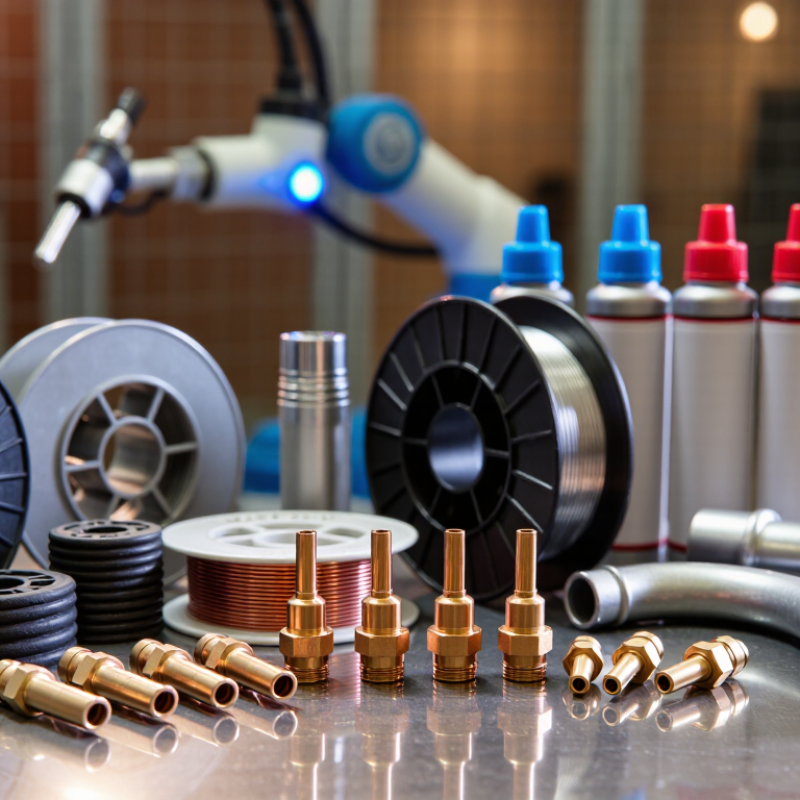
Robot welding consumables are the replaceable parts and materials that keep a welding cell working: wire, contact tips, liners, nozzles, and shielding gas. They influence wire feeding, arc stability, gas coverage, and bead consistency. A worn contact tip or a partially blocked nozzle can cause irregular arcs, excess spatter, or rework. Small parts. Big effects. With a robot repeating the same path, minor changes in wire condition or fit can become visible across many parts.
The International Federation of Robotics’ World Robotics 2024 report recorded 4.28 million industrial robots operating worldwide in 2023, a 10% increase from 2022. That figure covers all industrial applications, not welding alone, but it shows how widely automated production is used. In robot welding, consumables need to suit the wire, material, joint, and duty cycle—not just the machine. Even a good setup can drift. Operators should check wear and feeding conditions rather than assume a robot guarantees consistent welds.
Tip: Match the consumable specifications to the welding procedure, then track replacement intervals and wire-feed problems. Inspect the contact tip and nozzle after spatter buildup or a shift in arc behavior. Record what changes. The pattern may reveal more than a quick visual check.
| # | Consumable | What It Does | Common Options | What Buyers Should Check |
|---|---|---|---|---|
| 1 | Welding wire | Provides the filler metal for the weld and is continuously fed through the torch. | Solid wire or metal-cored wire; wire type and diameter depend on the base metal and welding procedure. | Confirm the required classification, diameter, surface condition, spool or drum format, and compatibility with the wire-feeding system. |
| 2 | Contact tips | Conduct electrical current to the wire while guiding it through the torch. | Copper or copper-alloy tips in different bore sizes, lengths, and duty ratings. | Match the tip bore to the wire diameter and verify the thread, seating style, and torch compatibility. Replace tips when wear causes inconsistent feeding or arc performance. |
| 3 | Gas nozzles | Direct shielding gas around the arc and weld area. | Different bore diameters and lengths; designs may be cylindrical, tapered, or recessed. | Choose a nozzle that provides suitable gas coverage and access to the joint. Check for spatter buildup, distortion, and fit with the torch assembly. |
| 4 | Gas diffusers | Distribute shielding gas through the nozzle and support the contact tip in many torch designs. | Different outlet patterns, materials, and thread or seating arrangements. | Verify compatibility with the torch, nozzle, and contact tip. Inspect for blocked or damaged gas passages that can disrupt shielding. |
| 5 | Wire liners | Guide the electrode wire from the feeder toward the torch contact tip. | Steel liners are commonly used for solid steel wire; low-friction liners are available for aluminum and other soft wires. | Match the liner to wire type, diameter, length, and torch system. Correct installation and cleanliness help reduce feeding resistance and wire buckling. |
| 6 | Drive rolls | Grip and push wire through the feeding system. | Groove profiles include V-shaped grooves for many hard wires and U-shaped grooves for soft wires. | Match the groove profile and size to the wire. Use the specified roll pressure; excessive pressure can deform wire or create feeding debris. |
| 7 | Torch necks | Position the front-end torch components and establish the torch angle for the programmed weld path. | Different lengths, angles, and cooling configurations are available for different access and duty requirements. | Check robot wrist clearance, joint access, torch mounting, and compatibility with the torch body. Confirm that the neck suits the required current and duty cycle. |
| 8 | Nozzle insulators | Electrically isolate and position the gas nozzle in torch designs that use a separate insulating component. | Shapes and materials vary by torch design and operating conditions. | Confirm the correct fit and replace cracked, heat-damaged, or contaminated insulators to help prevent electrical shorts and unstable operation. |
| 9 | Anti-spatter products | Help limit spatter adhesion on selected torch surfaces, fixtures, or workpieces. | Available as sprays, liquids, or gels; formulations differ in application method and residue behavior. | Check process compatibility, application instructions, and whether residue must be removed before painting, coating, or other downstream work. |
| 10 | Seals and O-rings | Help maintain gas-tight connections in torch and cable assemblies. | Sizes and materials vary by connection, torch design, and exposure to heat or chemicals. | Use the specified size and material. Replace worn, hardened, or damaged seals and check connections for leaks to protect shielding-gas coverage. |